


Ask a site manager what their lighting costs and most will quote the hire rate. The hire rate is rarely the expensive part. Fuel is. So is the bakkie that runs out to refuel, the operator hours spent doing it, the diesel that quietly disappears overnight, and the day a generator fails and half a shift stands idle.
Solar lighting towers change that arithmetic. They are not right for every site — but where they fit, they fit properly.
What actually differs
A diesel tower makes its own power continuously and needs feeding. A solar tower stores energy during the day and spends it at night. Everything else follows from that one difference.
- No refuelling run. No jerry cans, no fuel schedule, no vehicle and operator committed to the task.
- No fuel to steal. On remote and unmanned sites this is often the deciding factor, not a footnote.
- Effectively silent. That matters near residential boundaries, on night work, and anywhere a noise condition applies.
- No exhaust emissions at the point of use — relevant for enclosed or partially enclosed areas.
- Far fewer moving parts, so servicing is lighter: no oil changes, filters or fuel system maintenance.
The number that decides it
Work out your true cost per tower per month — hire or capital, plus fuel, plus the labour and vehicle time spent refuelling, plus losses. Compare that to a solar unit's cost over the same period. On long-duration sites the comparison usually gets decisive quickly.
Where solar is the obvious choice
Solar towers earn their place on:
- Long-duration sites where the unit stays put for months
- Remote or difficult-access locations where refuelling is a genuine logistical exercise
- Unmanned sites at night, where fuel and equipment security is a live problem
- Noise-sensitive locations and residential boundaries
- Security and surveillance duty, where the tower carries cameras as well as lights
Where diesel still wins
We would rather tell you this up front than sell you the wrong unit.
Diesel remains the better answer for short-duration hire where nobody wants to think about charge cycles, for very high continuous light output demands, and for genuinely unpredictable extended run requirements in poor weather. Some sites are best served by a mix.
Specifying a solar tower properly
- Define the coverage. Area to be lit, and to what standard — general site movement is a very different requirement to task lighting or camera coverage.
- Define the run time. Hours per night, and how many consecutive poor-weather days the unit must ride through.
- Check the mast. Height, deployment method, and wind rating for the conditions where it will stand.
- Confirm mobility. How it is towed, how it is levelled, and how quickly one person can set it up.
- Plan the extras. Cameras, lighting control and remote monitoring are far easier specified at purchase than retrofitted.
Fuel consumed, fuel delivered and fuel available to steal on a solar lighting tower. On remote and unmanned sites, removing the fuel logistics chain is frequently the real saving — not the electricity itself.
Don't forget the security case
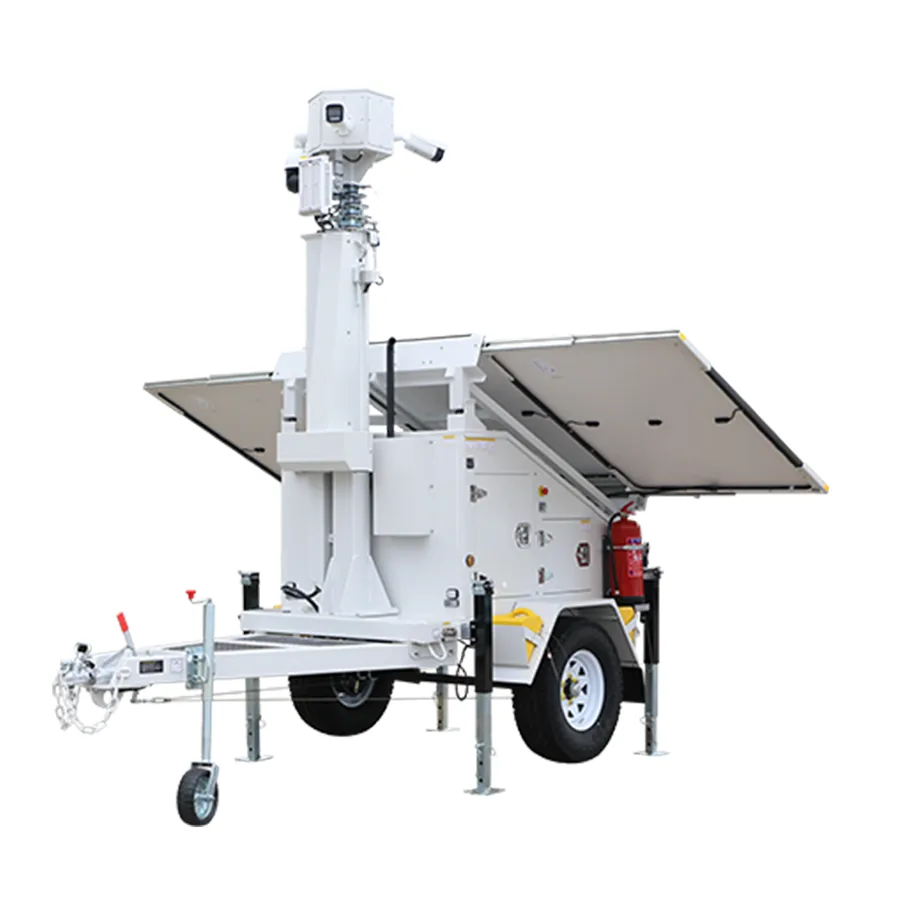
Lighting and surveillance increasingly arrive on the same trailer. A mobile solar unit carrying cameras gives you a monitored, illuminated presence that can be repositioned as the site develops — without trenching a single cable or running a generator all night to keep it alive.
On a remote site, the question is rarely which tower makes the most light. It is which one you can stop thinking about.
Industrial & site solutions
We supply solar lighting towers, mobile solar lighting trailers, surveillance trailers and solar street lighting through Blue Box Technologies. Tell us the site, the run time and whether you need cameras, and we will advise on the right configuration — with delivery arranged across Limpopo and further afield.
View site solutionsIn short
Compare total cost, not hire rate. Solar wins clearly on long-duration, remote, unmanned and noise-sensitive sites, and it wins hardest where fuel logistics and fuel security are real costs. Diesel still has its place on short hires and very high continuous output. Specify around coverage, run time and mast rating — and decide about cameras before you buy, not after.
Need help choosing the right industrial and site?
Tell us what you are working with and we will advise on options, pricing and lead times — usually within a business day. No obligation, no checkout.


